The website’s job has changed
A great business website in 2026 does far more than look good. It answers questions, wins trust and brings in enquiries, often while you’re busy doing the actual work.
Think about how your customers find you now. They search on Google, glance at your reviews, maybe ask an AI assistant for a recommendation, then tap through to your site on their phone. They decide within seconds whether to get in touch or move on.
We’ve been building websites since the 1990s, and we’ve seen every shift along the way: from the first dial-up business pages to smartphones, social media and now AI. This latest change is the biggest yet. Your website is no longer an online brochure. It’s your receptionist, your salesperson and your portfolio, working around the clock.
So what separates a website that works from one that just sits there? Here’s what we look for.
First impressions: fast and built for phones
Most people will visit your website on a phone, often on the move, on patchy signal, with one eye on something else. If your site is slow to load or awkward to use on a small screen, they’ll simply go back to Google and pick the next result.
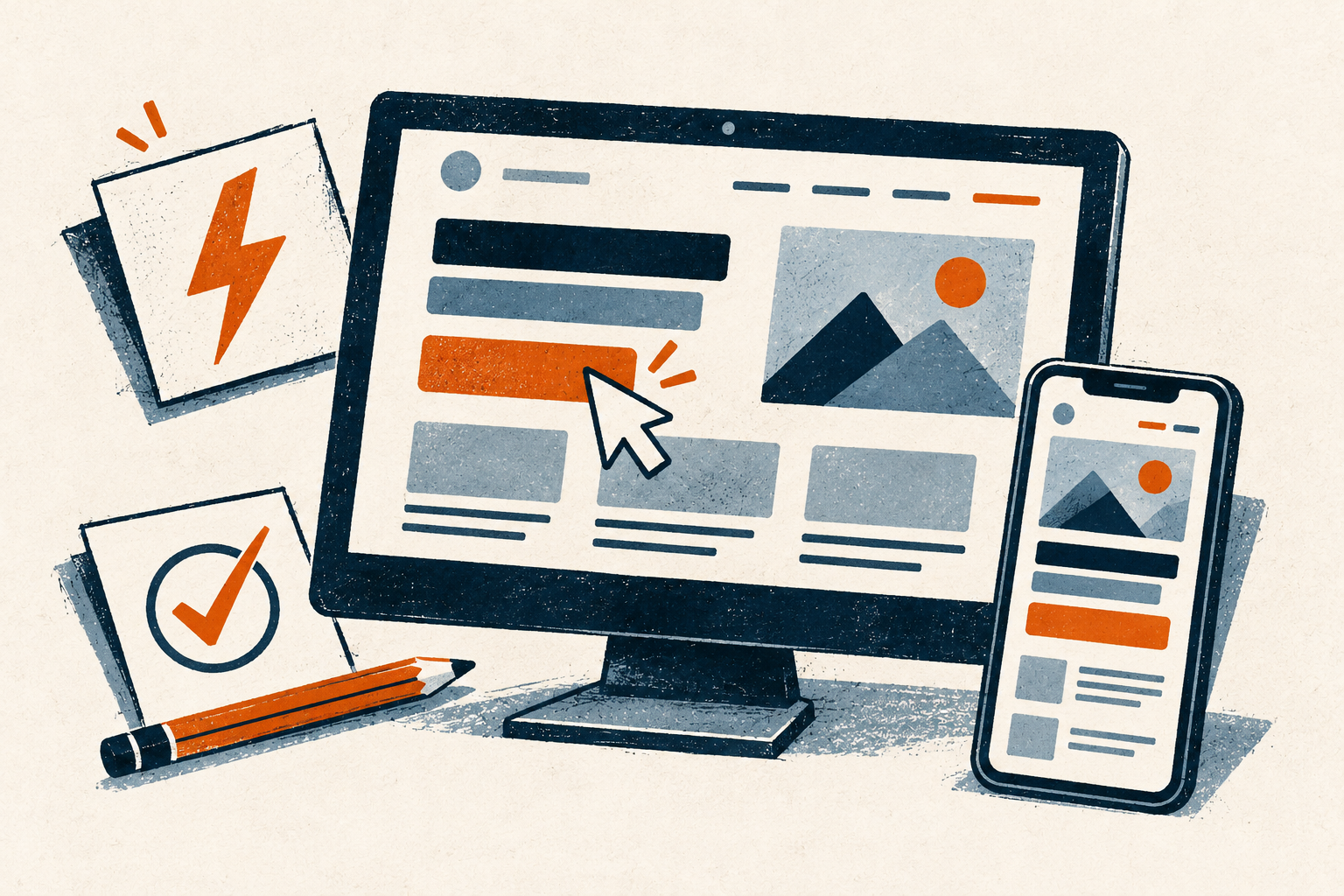
A great site in 2026 is designed for mobile first, then scaled up for desktop, not the other way round. Buttons are easy to tap, text is readable without pinching and zooming, and your phone number can be called with a single touch.
Speed matters just as much. Oversized images, too many plugins and cheap hosting are the usual culprits behind a sluggish site.
Quick check: open your website on your own phone, using mobile data rather than Wi-Fi. Does it load quickly? Can you find your contact details within a few seconds? If not, your customers can’t either. Google’s free PageSpeed Insights tool will also give you a score and point out what’s slowing things down.
A clear message in five seconds
When someone lands on your homepage, they should know four things almost instantly: who you are, what you do, where you work and how to get in touch. All of it should be visible without scrolling.
One of the most common mistakes we see is a clever slogan that doesn’t actually say what the business does. Compare these two headlines:
- “Solutions you can trust”
- “Emergency plumber in Watford, available today”
The first could belong to almost anyone. The second tells a visitor, and Google, exactly what you offer and where. It also answers the question they came with.
The same goes for your call to action. Make the next step obvious, whether that’s “Call now”, “Get a free quote” or “Book a consultation”, and repeat it throughout the page so it’s always within reach.
Real photography beats stock images
People can spot a stock photo a mile off. The beaming team in a glass office, the handshake over a laptop, the model holding a spanner they’ve clearly never used. These images don’t do any harm on their own, but they quietly tell visitors that what they’re looking at isn’t really you.
In 2026, with AI-generated images everywhere, authenticity matters more than ever. Customers want to see the real people they’ll be dealing with and the real work you produce.
The photos that make the biggest difference are usually the simplest:
- Professional headshots of you and your team
- Your premises, vehicles or workspace
- Your products, properly lit and styled
- Finished jobs and before-and-after shots
- Events, launches and behind-the-scenes moments
Good photography builds trust before a visitor has read a single word. It’s one of the best investments you can make in your website, and it pays off across your social media, Google Business Profile and marketing materials too. As photographers as well as web designers, we see the difference it makes every day.
Being found: Google, local search and AI
A beautiful website is no use if nobody can find it. For most small businesses, the customers who matter most are local, so local search should be your starting point.
The basics still make a huge difference:
- A complete, up-to-date Google Business Profile, linked to your website
- The same business name, address and phone number everywhere online
- Clear pages for each service you offer and each area you cover
- Page titles and headings that use the words your customers actually search for
There’s also something new to plan for. More and more people now ask AI assistants such as ChatGPT, Gemini and Claude to recommend a local business or explain a problem. These tools draw on websites that clearly explain what a business does, where it works and why it’s credible.
The best way to show up is the same as it’s always been: publish genuinely helpful content. Answer the questions your customers ask you every week. A simple FAQ page or a regular blog (like this one) gives both search engines and AI tools something useful to point people towards.
A website that works while you’re on the job
This is the biggest change we’re seeing in 2026. A great website no longer just collects messages for you to deal with later. It can actually help handle them.
AI assistants built into a website can now:
- Answer common questions about your services, prices and availability
- Take enquiries and booking requests outside office hours
- Ask the right questions up front, so you know what a job involves before you call back
- Send you a tidy summary, so no lead slips through the cracks
For tradespeople and busy small business owners, this is a game changer. If you’re up a ladder, under a sink or with a client, you can’t always answer the phone. And a customer who can’t get a response quickly will often try the next business on the list.
The key is getting the balance right. AI should support your personal service, not replace it. Set up well, it handles the routine questions and admin, and frees you up for the conversations that really need you.
Trust signals that turn visitors into customers
Before anyone picks up the phone, they want reassurance that you’re reliable. Your website should give them that reassurance without making them hunt for it.
The most effective trust signals include:
- Reviews and testimonials, shown prominently, ideally pulled through from Google so they’re clearly genuine
- Examples of your work, such as case studies, project galleries or before-and-after photos
- Credentials, including accreditations, trade body memberships, insurance and years in business
- Pricing guidance, even if it’s just typical starting prices or what affects the cost
Pricing is the one many businesses avoid, but it’s often what visitors want most. You don’t need a full price list. A simple “what to expect” section filters out time-wasters and makes serious customers more comfortable getting in touch.
The essentials people forget
Some of the most important parts of a website are the ones visitors never notice, until something goes wrong.
Security. Your site should run on HTTPS (the padlock in the browser bar). Without it, browsers may warn visitors that your site isn’t secure, which is the fastest way to lose their trust. Regular software updates and backups matter too.
Privacy and GDPR. Contact forms, cookies and mailing list sign-ups all involve personal data. You’ll need a clear privacy policy and a proper cookie notice, and you should only collect what you actually need.
Accessibility. A good website works for everyone, including people with visual impairments or who use screen readers. Readable text, strong colour contrast and descriptive image text help these visitors, and they help your search rankings too.
Easy updates. A website goes stale quickly. Make sure you can update your own content easily, or that someone is looking after it for you. Out-of-date prices, old photos and a blog last updated three years ago all send the wrong message.
Does your website pass the 2026 test?
Run through this quick checklist. If you can’t tick most of these, your website is probably costing you enquiries.
- ☐ It loads quickly on a phone using mobile data
- ☐ A visitor knows what you do and where you work within five seconds
- ☐ Your phone number and contact options are easy to find on every page
- ☐ It uses real photos of you, your team and your work
- ☐ Your Google Business Profile is complete and links to your site
- ☐ You have a page for each main service and area you cover
- ☐ Reviews or testimonials are clearly visible
- ☐ It can capture enquiries when you’re unavailable
- ☐ It shows the padlock and has an up-to-date privacy policy
- ☐ The content, prices and photos are current
Ready to make your website work harder?
A great business website in 2026 is fast, clear, genuine, easy to find and working for you around the clock. None of it needs to be complicated, but it does need to be done properly.
We’ve spent nearly 30 years helping businesses get online and stay ahead of each new change. As a small business ourselves, we understand the pressures you face: limited time, tight budgets and a hundred other things competing for your attention.
If you’re not sure how your current website measures up, or you’re starting from scratch, we’d love to help. Book a free, no-obligation consultation and we’ll talk through what your website needs to do for your business, and how to get it there.