
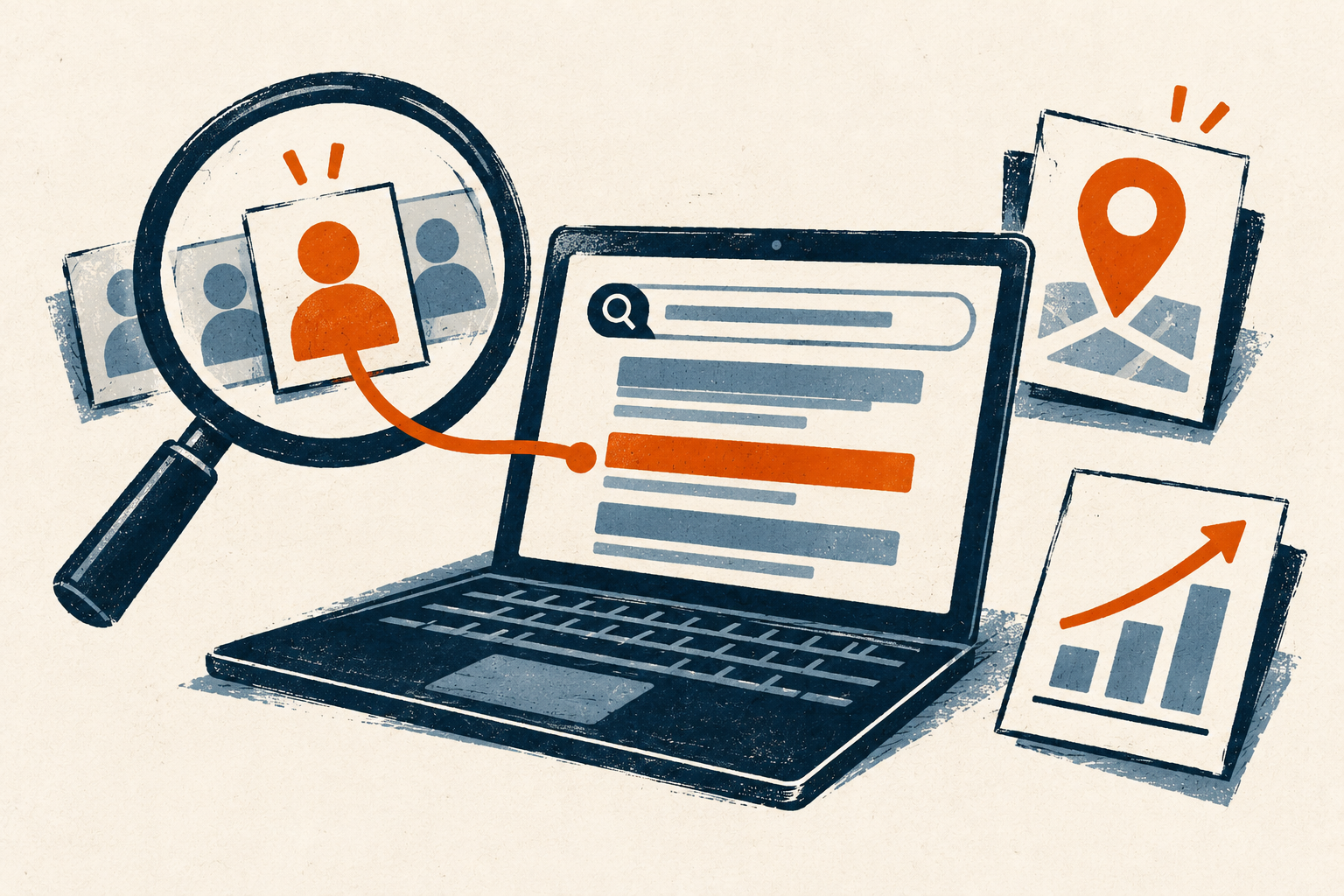
More traffic isn’t the goal
Good SEO doesn’t just bring more people to your website. It brings the right people: the ones looking for exactly what you offer, in the area you serve, and ready to get in touch.
A thousand visitors from the other end of the country, or looking for something you don’t sell, are worth far less than ten local people who need your help today. Yet many businesses chase big visitor numbers and wonder why the phone never rings.
SEO, or search engine optimisation, simply means making your website easy for search engines to understand and genuinely useful for the people searching. Do both well, and Google, and increasingly AI assistants, will send the right customers your way. Here’s how we approach it.
Start with your ideal customer, not keywords
Most SEO advice starts with keywords. We start with people. Before thinking about what to rank for, ask yourself three questions:
- Who is my ideal customer?
- Where are they based?
- What problem do they have at the moment they pick up their phone to search?
The answers change everything. Someone typing “why is my boiler making a banging noise” is researching. Someone typing “boiler repair Watford” is ready to book. Both could become customers, but they’re at very different stages.
The ready-to-buy searches should be covered by your service pages, with a clear way to get in touch. The research searches are best answered with helpful articles and guides that build trust, so when that person is ready, they remember you.
Speak your customers’ language
Every industry has its own jargon, and it’s easy to fill a website with it without noticing. The trouble is, your customers don’t search using trade terms. They search the way they talk.
An electrician might describe a “consumer unit replacement”. A homeowner is far more likely to search “new fuse box”. If your website only uses the first phrase, you could be invisible to the people who need you.
You don’t need expensive tools to find the words your customers use:
- Google’s autocomplete. Start typing a search and see what Google suggests.
- “People also ask”. These boxes in search results show the real questions people have.
- Your own enquiries. Write down the questions customers ask you on the phone and by email. They’re pure gold.
Use these everyday phrases in your headings and page content, alongside the correct terms. That way you’re clear to customers and credible to experts.
Local SEO: winning in your own area
For most small businesses, the best customers are nearby. Local SEO is how you make sure they find you rather than a competitor two towns away.
Make the most of your Google Business Profile. This is often the first thing people see, before they ever reach your website. Choose the most accurate business categories, list every service, add plenty of real photos and keep your opening hours up to date. Posting updates and offers regularly shows Google the business is active.
Create proper location pages. If you cover several towns, a page for each can help, but only if it’s genuinely useful. Pages that are identical apart from the town name rarely work and can harm your site. Talk about jobs you’ve done in the area, local landmarks or travel times, and anything specific to customers there.
Ask for reviews, every time. Reviews influence both where you appear in local results and whether people choose you. The simplest approach works best: ask happy customers straight after a job, and send them a direct link. Reply to every review too, good or bad. It shows future customers you care.
One page, one purpose
One of the quickest wins we see is splitting up the classic “Services” page. When every service sits on a single page, that page tries to rank for everything and usually ends up ranking for nothing.
Instead, give each main service its own page. A good service page:
- Focuses on one service and the searches that go with it
- Explains what’s included, who it’s for and what to expect
- Answers the common questions people have before they buy
- Shows relevant photos, reviews or examples of past work
- Ends with a clear next step, such as a call, quote request or booking
This helps search engines understand exactly what each page is about. More importantly, it means visitors land on a page that matches what they searched for, which makes them far more likely to get in touch.
Content that answers real questions
Helpful content is how you reach people earlier in their search, before they’ve decided who to call. A useful article, guide or FAQ builds trust, shows your expertise and gives people a reason to remember your name.
The best topics come straight from your customers. If you’ve been asked the same question five times this month, it deserves a page. Think:
- “How much does a new kitchen cost in 2026?”
- “What should I look for when hiring a wedding photographer?”
- “Do I need planning permission for a garden office?”
This kind of content matters even more now that people use AI tools to search. Google’s AI overviews and assistants such as ChatGPT, Gemini and Claude pull their answers from websites that explain things clearly and credibly. Content written to genuinely help people is exactly what these tools look for.
You don’t need to publish every week. One well-written, genuinely useful article a month will do far more than a stream of thin posts written just for search engines.
The technical basics, explained simply
You don’t need to become a technical expert, but a few foundations have to be in place. Without them, even great content will struggle to rank.
- Speed. Slow pages frustrate visitors and search engines alike. Compressing images and using decent hosting make a big difference.
- Mobile-friendly design. Google looks at the mobile version of your site first, so it needs to work well on a phone.
- A secure site. The padlock in the browser bar (HTTPS) is now expected as standard.
- Page titles and descriptions. These are what appear in search results. Each page should have its own, written to make people want to click.
- Clear headings. Well-organised headings help both readers and search engines understand your page.
- Image alt text. A short description of each image helps accessibility and gives search engines more context.
If you’re not sure whether your site has these covered, a quick review will usually spot any problems in minutes.
SEO myths and red flags
SEO has attracted more than its share of dodgy promises over the years. If you hear any of these, be cautious:
- “We guarantee you’ll be number one on Google.” Nobody can guarantee rankings. Google controls the results, not any agency.
- “We’ll get you hundreds of backlinks.” Bought or low-quality links can do real damage and may get your site penalised.
- “Just repeat your keywords as much as possible.” Stuffing pages with keywords makes them awkward to read and no longer works.
- “Do it once and you’re done.” Search changes constantly, and so do your competitors. SEO works best as a steady, ongoing effort.
A good SEO partner will be honest about what’s realistic. They’ll explain what they’re doing in plain English, focus on enquiries rather than vanity numbers, and tell you when something isn’t worth the money.
Measuring what matters
Rankings and visitor numbers are useful signs, but they’re not the real goal. What matters is whether your website brings in calls, enquiries and bookings from the kind of customers you want.
Three free tools from Google will tell you most of what you need to know:
- Google Search Console shows which searches your site appears for, how often people click through, and any technical problems Google has found.
- Google Analytics shows how visitors arrive, which pages they read and whether they go on to contact you.
- Google Business Profile insights show how many people found you in local search and Maps, and how many called, clicked or asked for directions.
It’s also worth simply asking new customers how they found you. Over time, you’ll build a clear picture of which pages and searches are bringing in real business, and where to focus next.
Bring in customers, not just clicks
SEO is a long game, but it’s one of the most valuable investments a small business can make. Get it right, and your website becomes a steady source of the right customers, month after month, without paying for every click.
The principles are simple: understand your customers, speak their language, be visible locally, answer their questions and keep the technical foundations solid. The hard part is finding the time to do it consistently.
That’s where we can help. We’ve been building and optimising websites for nearly 30 years, and we focus on results that matter to your business, not jargon or empty promises. Book a free consultation and we’ll take an honest look at how your website is performing in search, and what would make the biggest difference.