The latest official figures show the UK economy picking up speed, with technology leading the way. Here’s what that means for small businesses, and why those using AI are best placed to benefit.
If you run a small business, you’ll know the last couple of years haven’t always felt easy. Rising costs, cautious customers and a flat economy for much of 2025 made growth hard work.
So it’s worth pausing on some genuinely good news. The Office for National Statistics (ONS) has just published its first estimate of UK growth for July to September 2026, and the picture is brighter than it has been for some time. Even better, one of the biggest forces behind that growth is something every business can now tap into: technology, and increasingly, artificial intelligence.
The UK economy is picking up speed
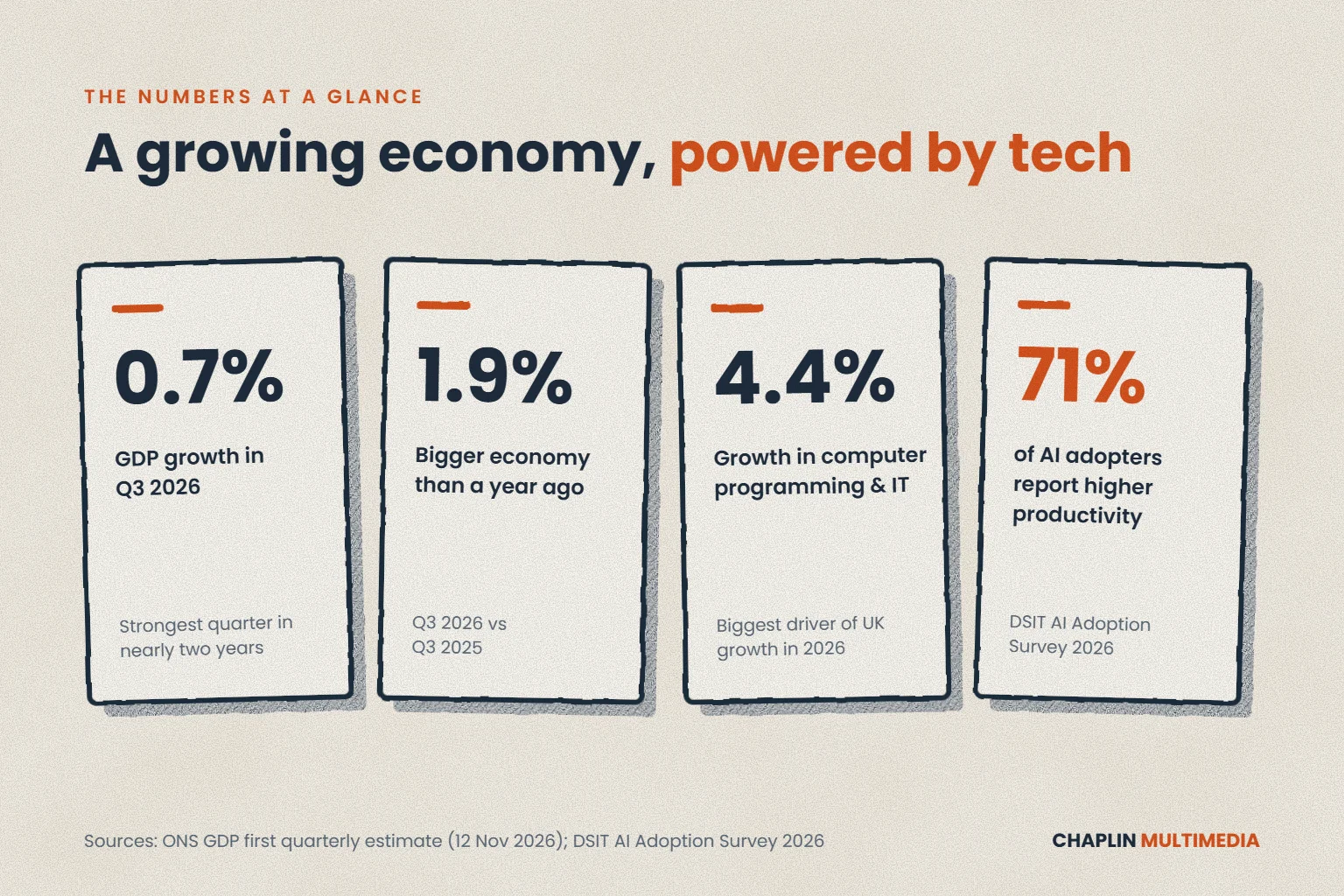
The UK economy grew by 0.7% between July and September 2026. That’s up from 0.5% in the spring and the strongest quarter in nearly two years.
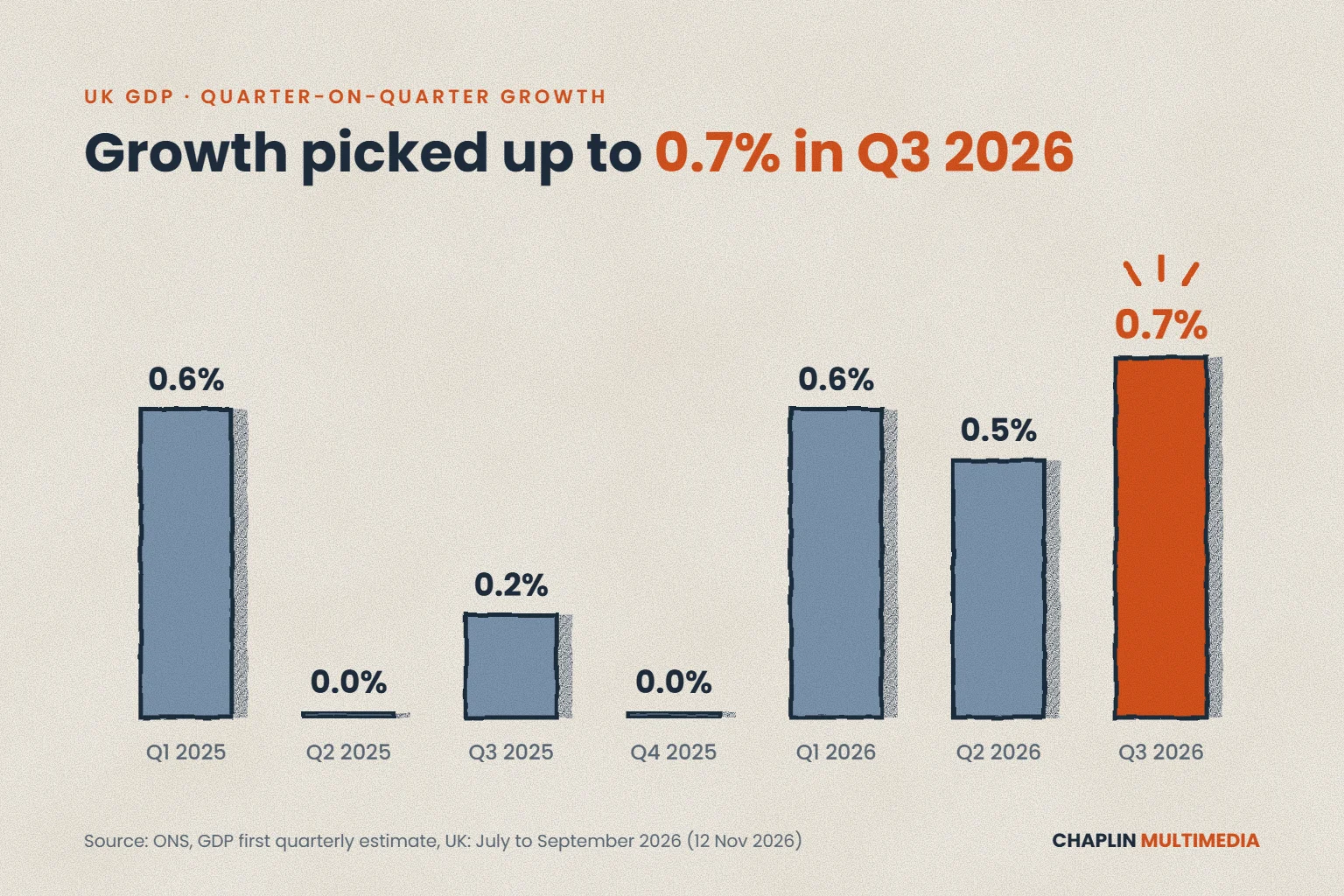
It’s also the third quarter in a row of solid growth, after a 2025 in which the economy barely moved. Put together, the economy is now 1.9% bigger than it was a year ago, and output per person is up 1.7%.
The growth is broad-based, too. Services grew 0.9%, manufacturing grew 0.9%, exports rose 1.6% and investment in things like equipment and buildings rose 1.7%.
It isn’t all one-way. Construction fell 0.7% over the quarter, and early GDP estimates are often revised as more data comes in. But the overall direction is clear: the UK economy is growing, and growing faster.
Technology is driving the growth, and AI is part of the story
Dig into the figures and one sector stands out. Information and communication grew 2.1% in the quarter, and within it, computer programming, IT consultancy and related services grew 4.4%. The ONS says this area has been the single biggest driver of UK growth across 2026.
Crucially, the ONS notes that the businesses reporting the biggest rises in turnover in this sector are often involved in AI and cloud computing. It isn’t only software, either: the manufacture of computers and electronics rose 4.6%, the biggest boost of any part of UK manufacturing.
It’s worth being clear-eyed here. The ONS says the exact contribution of AI is hard to measure, so nobody can honestly claim AI single-handedly grew the economy. But it’s fair to say AI is one of the forces behind the UK’s recent growth, and that the businesses building and using it are doing well.
Business-facing services, the firms that sell to other businesses, grew 1.0%, twice as fast as consumer-facing services at 0.5%. Businesses are investing in getting more done.
The AI advantage: why early movers are set to win
AI has gone from novelty to everyday tool remarkably quickly. According to the ONS, around 35% of UK businesses with ten or more staff were using AI by June 2026, up from about 12% in late 2023. That’s roughly a threefold rise in under three years.
And the businesses using it are seeing results. The Government’s AI Adoption Survey 2026 found that:
- 71% of businesses using AI report better workforce productivity
- 60% say their processes have become more efficient or flexible
- 24% have already cut their operating costs
Most aren’t using AI for anything exotic, either. The top uses are administration (81%), marketing (71%) and IT (66%). These are the everyday jobs every small business has to do.
Here’s the opportunity. Smaller firms are still well behind: 28% of micro-businesses (up to nine staff) use AI, compared with 49% of large firms. And the main thing holding businesses back isn’t the price of the tools. For 67% of AI users, the biggest barrier is a lack of skills or knowing where to start.
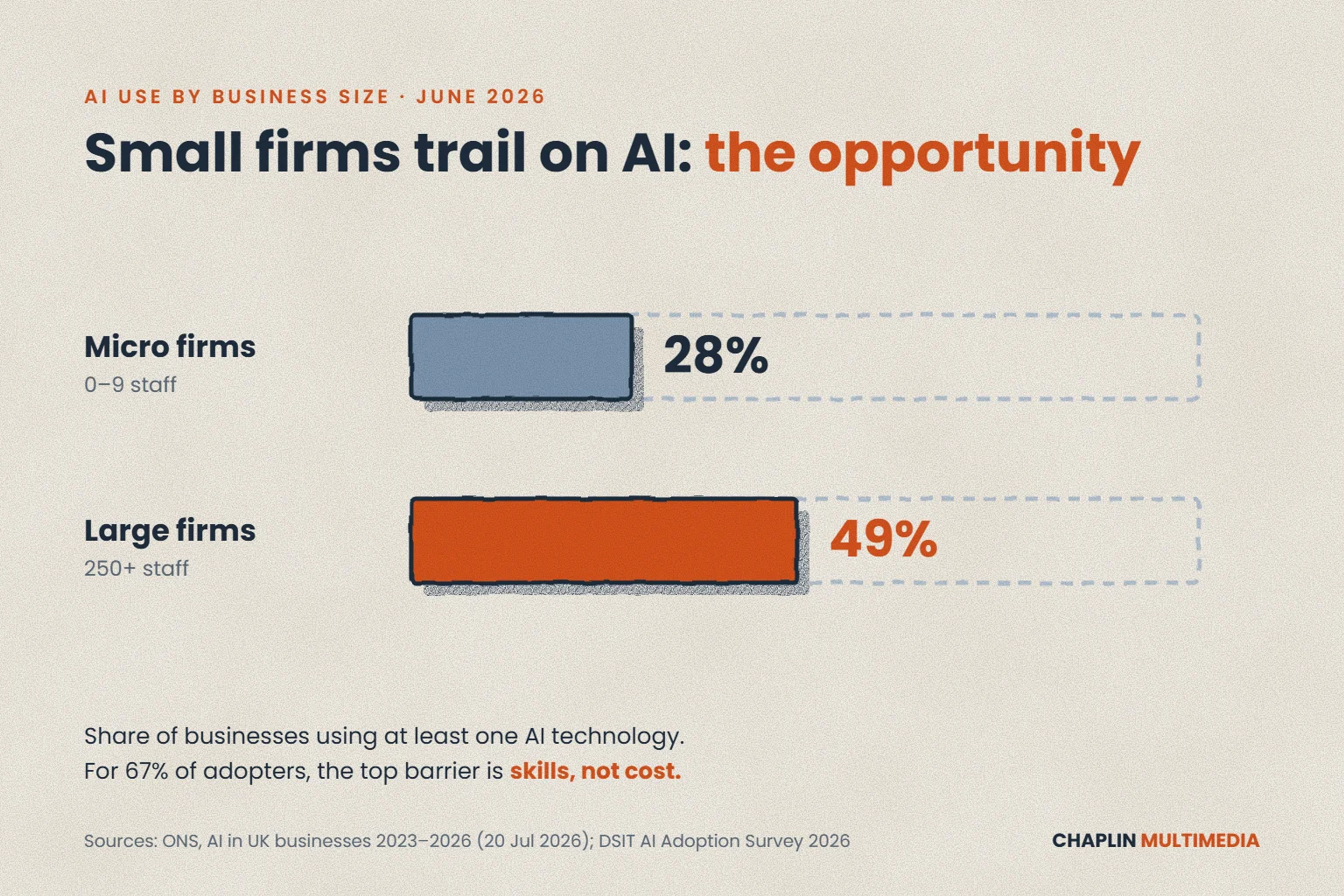
That’s good news. Skills can be learned, and help is easy to find. A small business that gets this right now can gain ground on bigger competitors while many are still hesitating.
What this means for your business
You don’t need a tech team or a big budget to benefit. Here are four practical places to start:
- Never miss an enquiry. An AI assistant can answer website and social media messages around the clock, qualify leads and book appointments. For plumbers, electricians and other trades who are busy on site all day, that can mean winning jobs that would otherwise go to the next number on Google.
- Cut the admin. Quotes, invoices, reminders and follow-up emails can be drafted or sent automatically, freeing up hours each week.
- Market consistently. AI can help you write social posts, newsletters and website updates in your own voice, so your marketing keeps going even when you’re busy.
- Start small, then build. Pick one time-consuming task, try an AI tool for a month and measure the hours saved. Once it works, move on to the next.
The key is to treat AI as a productivity tool first. Most businesses see the time savings before the cost savings, and those hours are what let you take on more work and grow.
Ready to make AI work for your business?
The economy is growing, and the businesses using technology well are getting the biggest share of that growth. The good news is that it’s not too late to join them.
At Chaplin Multimedia, we’ve been helping businesses across the South East adopt new technology since 1997, from building some of the first local council websites to creating AI assistants today. We understand the day-to-day pressures small businesses face, and we keep things practical.
Book your free AI audit and we’ll look at where AI could save you the most time, with no jargon and no obligation. Or get in touch for a free consultation.
Sources
- ONS: GDP first quarterly estimate, UK: July to September 2026 (12 November 2026)
- ONS: Artificial intelligence in UK businesses: 2023 to 2026 (20 July 2026)
- DSIT: AI Adoption Survey 2026 (29 October 2026)